BHSL Research

Tuesday, October 16, 2007

Welcome First Year Teachers!

Alix and I have used different features of "web 2.0" (using the web to present information as well as retrieve it) for today's presentation. Alix is using a website for teachers called 4Teachers.com which offers online tools and resources for both teachers and students. I will be using blogger.com which is a very user friendly blog format. Gary Prodanas will be showing you Moodle later in the year which combines many of the features of both.

Alix's website information on 4Teachers

Blogging can be such a boon to the busy educator. For example last year I facilitated a professional development course on Research in the Humanities. Through the miracle of modern technology I am able to use the same resources to show the databases to you!

Database Introduction

Big Chalk E-Library

Biography Resource Center

Groliers Encyclopedia

EBSCO Databases

Boston Public Library

Beverly Library Databases

Wednesday, January 10, 2007

January Professional Development

Once again, I am going to put this whole professional development day on-line in case I am hit by a bus or abducted by aliens again. (Long story...) But this time it is all in this one handy little blog post! Feel free to be as self-directed as you'd like to be. I will be wandering around so feel free to yell for me if you need any assistance or clarification.

Activity 1:
Do the Internet Discernment Lesson that I did with Niles' CP2 class. In an attempt to show students that not everything they find on the internet is accurate I put these beauties together. The class completed this lesson in 45 minutes. For fun, try to beat their time!
When you have completed the lesson, take a look at Kathy Schrock's website evaluation sheets.

Activity 2:
Go to the Downers Grove North High School Library Plagiarism Site. It is my favorite plagiarism site. Run through the list of Paper Mill Searches - take a look at the ones that interest you. Choose a couple of websites that interest you and read them. See if you can find the articles at the end via our Ebsco access.

Activity 3:
You have choices!

a. Write a research paper using the skills that you learned in the November p.d. class. Plagiarize as much as you like and then see if I can catch you!

b. I sent out an email asking who is currently working on a project integrating technology into their classrooms. Those people will give a brief picture of what they are doing. Feel free to jump onto their coattails as they develop the project.

c. Take the time you wished you had in the last p.d. class to look over the websites and databases that were presented. Wave your hand wildly in the air and shout if you have any questions or concerns.

Monday, November 06, 2006

Trust me, I'm a librarian...

Unless I went off on some startling tangents - everything that I will talk about at the professional development day is handily recapped on this page. All you need to do is scroll down to the bottom and read each post in backwards order. Or you can click on each one listed below in the proper order. The choice is yours.

Introduction - Nothing to see here really. I just feel bad leaving this off the list.

In the Beginning - The BHS library collection, the Beverly Public Library and Boston Public Library - knowledge at your fingertips.

Database Introduction - They are not websites! Learn the basics here.

eLibrary - My favorite database!

Biography Resource Center - Who are these people?

EBSCO - A big old bunch of information.

Grolier - Grolier Multimedia Encyclopedia and The New Book of Knowledge - for free!

Infotrac Junior and Kids Infobits - A little something for the ankle-biter in all of us.

¡Informe! - Hola Spanish Speakers! Este para tu!

Newsbank - It's local, it's historical, it's news!

New York Times - Start spreading the news...

Boston Public Library - Lots of free stuff here.

Internet Tips and Tricks

Really Useful Educational Websites

Indexes

Literary Criticism

BHS Faculty Website List

BHS Faculty Picks


BHS Faculty Picks
Originally uploaded by barbfecteau.

Here are the website picks that you were all (and at this point by "all" I mean Claire-Marie) kind enough to send me. If you are awash with guilt at reading this, and wish to email me your list, I will be happy to post them here.

CLAIRE-MARIE HART'S SITES

International Congress on Medieval Studies

Alibris - a great place for new used and out-of-print books.

Renaissance Dante in Print - Notre Dame, University of Chicago and The Newberry Library joined forces to create this collection.

The Princeton Dante Project

The Dartmouth Dante Project

College Board Information for Educators

DAN KELLEHER'S PICKS

Mount Holyoke College's International Relations Pages are excellent.

JANE COHEN

(in addition to the Rutgers page in the literary criticism section)

Community Learning Network - "A site designed to help K-12 teachers integrate technology into the classroom. Here you’ll find over 5,800 annotated links to educational sites with free resources, all organized by theme pages and keyword search."

Mr. William Shakespeare and the Internet - A comprehensive annotated guide to the scholarly Shakespeare resources available on Internet from Terry Gray of Palomar College.

Chaucer Pedagogy Page

Harvard Chaucer Page - This site provides materials for Harvard University's Chaucer classes in the Core Program, the English Department, and the Division of Continuing Education. (Others of course are welcome to use it.) It provides a wide range of glossed Middle English texts and translations of analogues relevant to Chaucer's works, as well as selections from relevant works by earlier and later writers, critical articles from a variety of perspectives, graphics, and general information on life in the Middle Ages. At the moment the site concentrates on the Canterbury Tales, but the longer-term goal is to create a more general Chaucer page.

Sunday, November 05, 2006

Literary Criticism


Literary Criticism
Originally uploaded by barbfecteau.

BHS Library has an excellent collection of casebooks as well as many volumes of Contemporary Literary Criticism. But the web offers access to literary criticism, particularly of newer writers, that we just can’t offer in print. But web-crit (okay, I just made that up, but I am hoping it will stick) is a dicey business, particularly if you are an easily suggestible teenager. There are a lot of great online book review sources.

Rutgers Literary Resources on the Net - "This set of pages is a collection of links to sites on the Internet dealing especially with English and American literature, excluding most single electronic texts, and is limited to collections of information useful to academics — I've excluded most poetry journals, for instance." according to site creator Jack Lynch, PhD.

ReviewsOfBooks is wonderful. It is a clearinghouse for full length newspaper and magazine reviews. It is not as comprehensive as I would like but in the words of Spencer Tracy “what’s there is cherce.”

Amazon will often reprint reviews from reputable sources like Library Journal or Publishers Weekly which can be convenient for less literary books.

Allreaders seemed like a good idea at the time, but it is useless for research. Everyone is referred to as a “resident scholar”. Which becomes increasingly more ironic the more of these reviews you read.

Indexes


Indexes
Originally uploaded by barbfecteau.
Indexes allow the researcher to find articles and other resources that are not generally available on the internet. Just about everything published after 1985 is available digitally if not for free, in paid databases. But prior to that (in most cases) hard copies are all that you can get. Once an article is located in an index, your friendly librarian can access the articles, either from back issues or from large libraries’ archives. And not just me, the librarians at your public library will find them too!

BHS library has the Readers’ Guide to Periodical Literature – the workhorse of indices – back to the early 1920s. Beverly Public Library offers an excellent online index, 19th Century Masterfile which combines Poole's Index to Periodical Literature 1802-1906, Index to Legal Periodical Literature (Jones and Chipman)1786-1922, Catalogue of Scientific Papers, the Religion Index 1890-1899x and more.

Websites


Websites
Originally uploaded by barbfecteau.

Here are some great resources for educational websites.

Librarians’ Internet Index is my favorite. It is indexed by subject and it is updated weekly. I often have better luck accessing websites through LII than I do through searching. And they are all high quality sites.

Blue Web’n is consistently recommend by librarians. New sites are constantly being vetted and they are organized in a very teacher friendly manner.

Marilaine Block’s Neat New Stuff on the Net
is geared towards librarians and is not indexed, but it is current and can be of use to anyone in education.

4Teachers - 4Teachers.org works to help you integrate technology into your classroom by offering FREE online tools and resources. This site helps teachers locate and create ready-to-use Web lessons, quizzes, rubrics and classroom calendars. There are also tools for student use. Discover valuable professional development resources addressing issues such as equity, ELL, technology planning, and at-risk or special-needs students. (Thanks - Ellen Comiskey for showing me this!)


Kathy Schrock – the librarian everyone I know aspires to be – catalogs sites for discovery school.com.

Are you working on a class wide research project on a specific era, writer or subject? Ask your friendly librarian for site lists (a week in advance) and she can post it here for you!

Internet - Taming the Beast!


Wikipedia
Originally uploaded by barbfecteau.
There are many different search engines available. Each individual needs to find the one that works best for them. I use Google because they send me a newsletter every month with secret librarian tricks and tips to make me more effective. Also, it tends to be the one that students are most likely to use. Here is a fantastic guide to search engines categorized by the circumstances under which they would best be used.

When using Google use the “advanced search” tag over to the right of the search box. This allows you the option of Boolean search terms as well as restricting searches by domain name, time, language and other options. I tell students that the domain name option is great because it can allow you to look at.edu, .gov and .mil sites depending on what their search needs are. These types if sites are easier to qualify because the authors or responsible parties are generally easier to determine. It used to be that .org and .net were thought to be more reliable, but that is no longer the case. Those domains do let the searcher know how the organization defines itself, but they say nothing about bias, accuracy or motives of the creators of the site.

When you come across good information but are unaware of the source, often truncating the URL can be useful. Just chop off the last bit of the URL (the website’s address) and see what happens. Often an article will be part of a series for a university class and eventually the truncation will lead to an index page that will name the author or the responsible party. At the very least it will give you the name of the institution from which the work was generated and you can email for more information.

When web searching quotation marks can be your best friends. Where Boolean searching has become mostly passé, putting quotes around some of your search terms can help narrow your search. Also adding the phrase “primary document” or “full text” can make finding specific works easier. Many poems, short stories, speeches and the like can be located this way.

Wikipedia is such a pain in my neck. I love it for its communal nature, but since it gets so many hits, it is nearly always in the top 10 results for any students search. It is not that it is full of lies as some would claim, but that it is not always entirely true. Some entries are excellent, but it is a case of needing to throw the baby out with the bathwater. Assuming of course that it wasn’t that great a baby to begin with and that you have an unlimited supply of other babies. Maybe a different metaphor would have worked better here. I tell kids that it is a good source for quick background information but little else. And then I show them the interesting entry on Lucy Larcom. See if you can find the cleverly placed misinformation! Also, the site about.com often takes their information directly from Wikipedia making in just as unciteable.

Saturday, November 04, 2006

Boston Public Library


Boston Public Library
Originally uploaded by barbfecteau.
For a limited time only, the Boston Public Library is offering Massachusetts residents to apply for a temporary BPL library card online. This gives you access to all of their databases which I urge you to explore.
The two that fill my heart with song are the New York Times Archives and Jstor. Jstor offers full-text access to nearly 600 core scholarly journals covering 44 specialized subject areas. Complete back runs of many titles available. The card is only good for six months, but if you are willing to go all the very far way to Boston, you can get an actual card that will be yours forever and allow you this research bounty until your dying breath.

Beverly Public Library also has American Periodicals Series Online, a primary resources database for American History that is accessible from home via their website. And OF COURSE you already have a library card for there! If you are not a Bevelry resident you can use the school's card number. It is hanging over the library computers. Make sure to urge your students to get a Beverly library card of their own.

New York Times


New York Times
Originally uploaded by barbfecteau.
This is absolutely invaluable for researching any historical or literary topic post-1851. The search engine allows you to have results listed in chronological order so you can watch the progression of your topic as it hits the consciousness of the world via the world’s premiere English language newspaper. Take that, London Times… The index is free, but articles cost $2.95 apiece. (But not really, see next entry!)

Newsbank


Newsbank
Originally uploaded by barbfecteau.
This paid database offers full text articles from area newspapers: Boston Globe (1980-current), Boston Herald (1997-current), and Worcester Telegram & Gazette (1989-current) This is particularly useful for current events at a local level. Stories can be searched from both Boston papers and presented to show perspective.

¡Informe!


¡Informe!
Originally uploaded by barbfecteau.
"¡Informe! (Revistas en Espanol) is the first reference database to provide indexing, full text, and images of the most popular Hispanic magazines. It also includes full text pamphlets on a variety of topics, such as health care." according to the Infotrac.

I have never actually used this database, but it seems like if one were able to speak Spanish, it would be very useful. Also, since I have probably talked about absolutely nothing useful for language teachers at this point, I am throwing them a bone. Enjoy!

Infotrac Junior and Kids InfoBits


Infotrac Junior
Originally uploaded by barbfecteau.
These are essentially more basic versions of eLibrary or EBSCO. They are image heavy with kid friendly icons and search paths. There are far fewer resources available, but they are far easier for students not working at grade level or those for whom too much information is daunting.

Grolier


Grolier
Originally uploaded by barbfecteau.
Grolier’s online encyclopedia has two options – Grolier Multimedia Encyclopedia and The New Book of Knowledge. The New Book of Knowledge is geared for younger readers and is easily navigable with simpler vocabulary. The Multimedia Encyclopedia is more in depth and is an excellent alternative to Wikipedia. Even if you disallow encyclopedias in your works cited for research papers, students should be aware that you can’t beat them for finding background information. Grolier also has many and more versatile visual resources than a simple print encyclopedias.

EBSCO


Ebsco
Originally uploaded by barbfecteau.
This search system can be quite frustrating. The subject searching seems to work better for me than keywords. I put in a fairly general search and then use the terms in the left hand column to help me refine. The thing that I love about EBSCO’s set up is the ease of finding articles that you already know where they are. For example – a history teacher often sends kids down to find specific articles from specific issues of American History Illustrated magazine. If they have the date of the issue they can easily browse that issue’s contents until they find the article. (Although having the correct title is easier – I can dream…) The only downside is that the magazines that are available in full text tend not to be back cataloged. So if you are looking for an issue that came out before 1985 (or even later depending on the magazine) you are out of luck. But you do have other options that we will look at in the indexes section.

Biography Resource Center


Biography Resource Center
Originally uploaded by barbfecteau.
Biography Research Center is a great place to fine different types of digitized reference books. There is an entry for nearly everyone who ever existed. Often there are several different bents to the articles based on the work from which they come. For example, Charles Darwin is in the Encyclopedia of World Biography and World Eras, Vol. 9: Industrial Revolution in Europe (1750-1914) as well as 14 other sources. The search parameters are very interesting so that if the student is looking for geneticists he can use that as a search term as well as the country of origin . The results are tabbed so that you can also access magazine articles and vetted websites.

Thursday, October 26, 2006

Big Chalk eLibrary


eLibrary - Free and awesome!
Originally uploaded by barbfecteau.
ELibrary is my personal favorite. It has cute little icons that tell you where the resource is coming from. It allows you to list your findings chronologically (although only from most recent which is no fun). It has transcripts of just about every broadcast NPR has ever had. The subject search is very effective. There are many wonderful things about this database.
Most of the databases we have access to have articles from the mid-80s on. So if you are looking for primary resources, you are going to be better served by the web or more historical databases that I will get to later on.
But for anything post 1980's - eLibrary is the place I go first.

Monday, October 23, 2006

Databases are not websites!


A database is not considered an internet source. Even though we access the databases through the internet, they are actually print collections. They are articles, entries, essays, podcasts, transcripts and images that have been through the same editorial process that the printed page goes through.

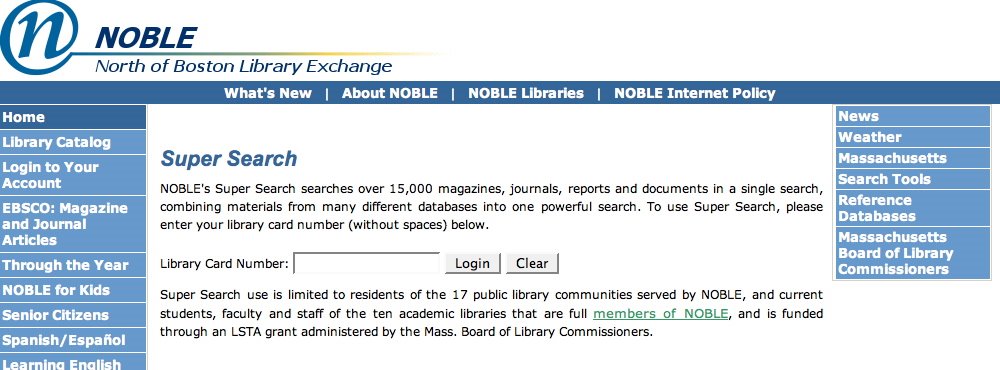
The databases that we predominantly use at BHS are those available through Noble - the same Noble that has that awesome OPAC that you just looked at! (And yes, this is the first recorded instance of an OPAC being called "awesome".) See that little box over there on the right that says "reference databases"? If you click on that it will take you to the "Answers To Go" page. This is the list of databases that are provided by the Massachusetts Board of Library Commissioners. They are my favorite commissioners of all time for just that reason.

Once you choose your database and click on it you will be taken to the MBLC page that looks a little something like this:

Now you need to enter your library card number in the little box that is near the middle of the page and click "go". If you don't have a library card, please leave your resignation at the main office on the way out. If you don't have you library card with you you can use BHS's number which is hanging on the wall of the library over the student computers.

Once you type in your number you will be taken to the database you have chosen and begin the wonderful task of database research!

In future posts I will highlight the databases that I find particularly useful and completely gloss over the ones that give me a pain in the neck. So let us recap what we have learned:
1. Databases are not websites.
2. The Mass. Board of Library Commissioners rocks! (And yes, that is the first recorded instance of the MBLC being accused of rocking. )

Coming soon - Big Chalk e-library!

Friday, October 06, 2006

In the beginning...


Our own Athena!
Originally uploaded by barbfecteau.
We used to have a card catalog. You may notice that whenever I write a pass for a student, it is on a little card with a hole in it. That is what is left of the card catalog. Now we have an OPAC - an online public access catalog. Ours is named Athena, after the goddess of frustratingly fruitless searching - I mean, wisdom and the practical arts.

The Athena catalog tells what books we have, where they are located in the library and if a book is available. However you can't view Athena's holdings outside the library.

We do belong to a consortium of school libraries called MassCat and our holdings can be viewed in their catalog. We are also in a pilot program wherein we can borrow holdings from other libraries. So if you are searching the catalog and see something you would like, feel free to come ask me to get it for you! Or if you are feeling especially adventurous you can request it yourself by clicking the "request this item" link.

The catalog I use the most and that I tell students to use is the NOBLE catalog. This is the North Of Boston Library Exchange. There are so many resources available here that you will be shocked.

You can also access the Boston Public Library's OPAC online. As a matter of fact, just about every public library has their catalog online. Since there are standard subject headings in library catalogs browsing is extremely easy when looking for books or media on a specific topic.

Friday, September 22, 2006

That was great, Barb!

If you are reading this, you have successfully made it through the first attempt I have ever made at teaching professional development. I wonder how it went? Were you fascinated? Did it revive your joy of learning? Are you silently mocking me as you read this? Oh, to see the future.

Anyway, the purpose of this blog is to allow you to have the information that has surely already fallen from your brain at your fingertips. (And I mean the information is at your fingertips, not your brain is at your fingertips.) So I will outline what we should have gone over and I will give you the necessary links to find these research portals.

The obvious difficulty is that with a blog, the most recent information is at the top and the oldest posts are nearly impossible to get to. Which means the very words I am typing now - my first of this venture - will be virtually smothered by the stuff I will write later. If I can technologically change the order of the posting, than I will. (And so if this appears at the beginning of the blog, you should be very impressed right now!) If not, I will make a final post with live links to each and every post so that your navigation will be easier.

And so, we are off on the adventure of research in the humanities... (insert old fashioned science fiction movie music here)